Tuesday, October 20, 2020

What problem world scientist has to solve?

 Problem we have in hand?

  • SOLAR
  • WIND 
  • PLASTIC
  • BUSH FIRE
  • BATTERY
  • LANDFIELD- DUMPING GROUND WASTE

SOLAR

Smaller size solar panel to generate more energy or equivalent energy as per size given today

WIND ENERGY

localizing wind turbine plant to individual home/business

PLASTIC

Alternative to plastic. These days everything is plastic

BUSH FIRE

Contain or prevent Bush fire

BATTERY

Small size battery to power your house and car. Compact small yet powerful

LANDFIELD

Technology to reduce landfield waste , electronic waste and so on.


Wednesday, October 7, 2020

Android Device Terms you should be familiar of

ROM is simply a modified version of an Android operating system all of our Android devices come with a default ROM by the manufacturer, but we can modify this.

AOSP. Android Open Source Project. Now this is just simply the operating system, the Android operating system completely stripped down, and it's given to developers and manufacturers so they can go through and customize it to create their own ROM. 

Firmware. Now firmware is kind of like a driver. It's just a piece of software that makes the hardware function correctly with the OS. 

Open source is a piece of software that's free to edit and to be used or distributed and shared at no charge. 

Bloatware.  This is software or applications that are installed on your mobile devices that you don't necessarily need, that the manufacturer and/or the OEM has agreements with these pieces of software. They're actually making a little bit of a money on the backside for every activation, you know, for example, Dropbox. Dropbox pays to get their app installed automatically on your Android device. Now because these are pre-installed, 

APK.  Android application package. This is the file extension for applications in the Android environment. So for example, fortnite would have a fortnite.apk would be the name of the file. 

Tuesday, July 28, 2020

Commutative, Associative and Distributive Laws

Commutative, Associative and Distributive Laws

Wow! What a mouthful of words! But the ideas are simple.

Commutative Laws

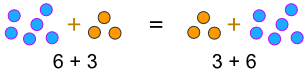
The "Commutative Laws" say we can swap numbers over and still get the same answer ...
... when we add:
a + b  =  b + a

Example:

Commutative Law Addition

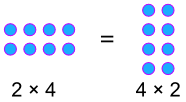
... or when we multiply:
a × b  =  b × a

Example:

Commutative Law multiplication

Commutative Percentages!

Because a × b  =  b × a it is also true that a% of b  =  b% of a

Example: 8% of 50 = 50% of 8, which is 4


commute
Why "commutative" ... ?
Because the numbers can travel back and forth like a commuter.


Associative Laws

The "Associative Laws" say that it doesn't matter how we group the numbers (i.e. which we calculate first) ...
... when we add:
(a + b) + c  =  a + (b + c)
Associative Law addition
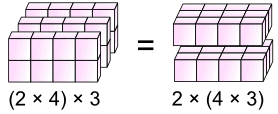
... or when we multiply:
(a × b) × c  =  a × (b × c)

Associative Law multiplication

Examples:

This:(2 + 4) + 5  =  6 + 5  =  11
Has the same answer as this:2 + (4 + 5)  =  2 + 9  =  11

This:(3 × 4) × 5  =  12 × 5  =  60
Has the same answer as this:3 × (4 × 5)  =  3 × 20  =  60

Uses:

Sometimes it is easier to add or multiply in a different order:

What is 19 + 36 + 4?

19 + 36 + 4  =  19 + (36 + 4) 
=  19 + 40 = 59
Or to rearrange a little:

What is 2 × 16 × 5?

2 × 16 × 5  =  (2 × 5) × 16 
=  10
 × 16 = 160

Distributive Law

The "Distributive Law" is the BEST one of all, but needs careful attention.
This is what it lets us do:
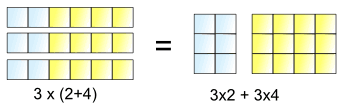
Distributive Law
3 lots of (2+4) is the same as 3 lots of 2 plus 3 lots of 4
So, the 3× can be "distributed" across the 2+4, into 3×2 and 3×4
And we write it like this:
a × (b + c)  =  a × b  +  a × c
Try the calculations yourself:
  • 3 × (2 + 4)  =  3 × 6  =  18
  • 3×2 + 3×4  =  6 + 12  =  18
Either way gets the same answer.
In English we can say:
We get the same answer when we:
  • multiply a number by a group of numbers added together, or
  • do each multiply separately then add them

Uses:

Sometimes it is easier to break up a difficult multiplication:

Example: What is 6 × 204 ?

6 × 204  =  6×200 + 6×4
=  1,200 + 24
=  1,224
Or to combine:

Example: What is 16 × 6 + 16 × 4?

16 × 6 + 16 × 4  =  16 × (6+4)
= 16 × 10
=  160
We can use it in subtraction too:

Example: 26×3 - 24×3

26×3 - 24×3 = (26 - 24) × 3
=  2 × 3
=  6
We could use it for a long list of additions, too:

Example: 6×7 + 2×7 + 3×7 + 5×7 + 4×7

6×7 + 2×7 + 3×7 + 5×7 + 4×7
= (6+2+3+5+4) × 7
= 20 × 7
= 140

And those are the Laws . . .

                  . . . but don't go too far!

The Commutative Law does not work for subtraction or division:

Example:

  • 12 / 3 = 4, but
  • 3 / 12 = ¼
 The Associative Law does not work for subtraction or division:

Example:

  • (9 – 4) – 3 = 5 – 3 = 2, but
  • 9 – (4 – 3) = 9 – 1 = 8
 The Distributive Law does not work for division:

Example:

  • 24 / (4 + 8) = 24 / 12 = 2, but
  • 24 / 4 + 24 / 8 = 6 + 3 = 9

Summary

Commutative Laws:a + b  =  b + a
a × b  =  b × a
Associative Laws:(a + b) + c  =  a + (b + c)
(a × b) × c  =  a × (b × c)
Distributive Law:a × (b + c)  =  a × b  +  a × c

China , US, Australia , Japan and India rising tension and a protracted cold war

Bulletin TheAustralian reported...
Escalating hostilities between China and the US are reaching a point of no return. US Secretary of State Mike Pompeo has delivered his most damning indictment of the Chinese Communist Party to date. Rumination about war developing between the two nations has been superseded by concern over whether the US is prepared to defend itself as well as allied states should relations deteriorate.
The Australian government is no longer sitting on the fence. It has taken the moral high ground by siding with the leader of the free world. However, without sufficient military preparation or a geopolitical strategy that establishes new alliances and trade diversification, our capacity to survive a protracted cold war with China is limited.
Under Xi Jinping, China has become a menace to the international community.
TheGuardian

Australia to step up South China Sea defence cooperation with US – but won't commit to patrols

Allies release joint statement of ‘deep concern’ over China’s actions in Hong Kong and repression of Uighurs and vow to fight disinformation
Australia has pledged to increase defence cooperation with the US in the South China Sea – but stopped short of making any specific new commitment on freedom of navigation operations, despite American pressure.
The two allies have also decided during high-level talks in Washington to set up a working group to push back at false information across the Indo-Pacific region, warning that “state-sponsored malicious disinformation and interference in democratic processes are significant and evolving threats”.
While the joint statement expressed “deep concern” over a range of actions taken by China – including a “campaign of repression of Uyghurs” and undermining of freedoms in Hong Kong – Australia’s foreign affairs minister, Marise Payne, said her country had “no intention of injuring” its important relationship with Beijing.
Payne and the defence minister, Linda Reynolds, agreed in face-to-face talks with their US counterparts, Mike Pompeo and Mark Esper, to pursue “increased and regularised maritime cooperation” in the South China Sea and the Indian Ocean, “bilaterally and in concert with other likeminded and regional partners”.
The joint statement declares that Beijing’s maritime claims in the South China Sea “are not valid under international law”, but Australia appears to have held firm against conducting freedom of navigation exercises within 12 nautical miles of disputed features.
Experts say the US has long been pushing for Australia to conduct such exercises, but Australia has resisted taking such a step to date – in part to avoid inflaming tensions with China, its largest trading partner.
Payne said Australia and the US had a close and enduring relationship but made their own decisions based on their values.


Wednesday, July 22, 2020

Amazing collaboration- Anywhere to everywhere

If I meant to be CEO of Zoom, Google Meet , Microsoft Teams or skype I would have my punch line for my digital collaboration tool. 
Amazing meeting- Anywhere to everywhere
Having said that just imagine while I say that I mean who work remotely , it doesn't matter . You can be taking a call while in your backend, or any extreme  end of the country. You are still connected from anywhere to everywhere. We touch every life. 
CIRCLE OF LIFE!

Friday, July 17, 2020

Triangular Number Sequence

Triangular Number Sequence

This is the Triangular Number Sequence:
1, 3, 6, 10, 15, 21, 28, 36, 45, ...
It is simply the number of dots in each triangular pattern:
triangular numbers
By adding another row of dots and counting all the dots we can
find the next number of the sequence.
  • The first triangle has just one dot.
  • The second triangle has another row with 2 extra dots, making 1 + 2 = 3
  • The third triangle has another row with 3 extra dots, making 1 + 2 + 3 = 6
  • The fourth has 1 + 2 + 3 + 4 = 10
  • etc!
How may dots in the 60th triangle?

A Rule

We can make a "Rule" so we can calculate any triangular number.
First, rearrange the dots like this:
triangular numbers 1 to 5
Then double the number of dots, and form them into a rectangle:
triangular numbers when doubled become n by n+1 rectangles
Now it is easy to work out how many dots: just multiply n by n+1
Dots in rectangle = n(n+1)
But remember we doubled the number of dots, so
Dots in triangle = n(n+1)/2
We can use xn to mean "dots in triangle n", so we get the rule:
Rule: xn = n(n+1)/2
Example: the 5th Triangular Number is
x5 = 5(5+1)/2 = 15
Example: the 60th is
x60 = 60(60+1)/2 = 1830
Wasn't it much easier to use the formula than to add up all those dots?
log stack

Example: You are stacking logs.

There is enough ground for you to lay 22 logs side-by-side.
How many logs can you fit in the stack?
x22 = 22(22+1)/2 = 253

The stack may be dangerously high, but you can fit 253 logs in it!